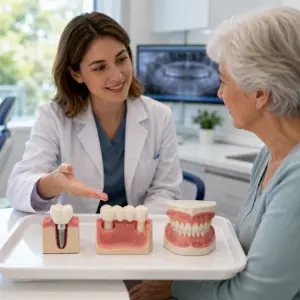
When you are missing a tooth (or several), the best solution is not always the same for every mouth. The right choice depends on your health, your bite, the condition of nearby teeth, and how you want your replacement to look and feel day to day. If you are researching dental implants in Yorba Linda, it helps to compare them to two common alternatives: bridges and dentures.
In our previous blog, "Can Family Dentists Perform Dental Implants? | Yorba Linda," we discussed how family dentists can place implants. In this article, we focus on how to decide between implants, bridges, and dentures.
TL;DR - A Simple Way To Pick The Right Tooth Replacement
If you want the most natural, fixed feel and you have adequate bone support, implants are often a strong long-term option. Bridges can be great when neighboring teeth already need crowns, and dentures can be a practical choice when multiple teeth are missing or you want a removable solution.
- Choose implants if you want a fixed solution that does not rely on neighboring teeth.
- Choose a bridge if the teeth next to the gap already need crowns or have large fillings.
- Choose dentures if you need to replace many teeth or prefer a removable option.
- Maintenance matters: bridges need special cleaning under the connector; dentures need daily removal and cleaning.
- Ask about bone support and bite before deciding, especially for back teeth.
Start With Your Goal: Fixed, Removable, Or Something In Between?
Before comparing pros and cons, decide what matters most to you:
- Feel: Do you want something that stays in all the time, or is removable?
- Appearance: Are you focused on a single front tooth, or rebuilding a full smile?
- Chewing comfort: Do you want a replacement that feels stable for tougher foods?
- Long-term maintenance: Are you comfortable using floss threaders, cleaning devices, or removing an appliance daily?
As a general dentistry team, one clinical observation we see often is that the option patients like best long-term is the one that matches their daily habits. Even an excellent restoration can feel frustrating if the cleaning routine does not fit your lifestyle.
Option 1: Dental Implants (A Tooth Root Replacement)
A dental implant replaces the root of a missing tooth with a small post placed in the jawbone, then supports a crown that looks like a natural tooth. If you are comparing options with an implant dentist in Yorba Linda, implants are often considered when you want a stable, fixed solution that does not depend on adjacent teeth.
For a deeper overview of candidacy and benefits, visit our service page on dental implants in Yorba Linda.
Why People Choose Implants
- Independent support: does not need neighboring teeth to hold it up.
- Natural function: many patients find chewing and speaking feel more natural.
- Bone support: can help maintain the bone in the area where a tooth is missing (depending on anatomy and timing).
- Versatility: can support a single crown, multiple teeth, or stabilize some denture designs.
When Implants May Not Be The First Choice
- Bone volume concerns: some cases need additional procedures before implant placement.
- Healing timeline: treatment may require multiple stages.
- Medical and bite factors: your dentist will review health history and bite forces before recommending an implant.
Option 2: Dental Bridges (A Fixed Replacement Anchored To Neighboring Teeth)
A traditional bridge uses the teeth on either side of the missing tooth as anchors (abutments). Crowns go over these supporting teeth, and a false tooth fills the gap. Bridges are fixed in place, meaning you do not remove them at home.
Why People Choose Bridges
- Fixed solution: it stays in, like a crown.
- Efficient replacement: can be a straightforward way to fill a gap.
- Helpful when neighbors need crowns: if adjacent teeth already need significant restoration, a bridge may align with that plan.
Tradeoffs To Know About
- Neighboring teeth are involved: healthy teeth may need to be reshaped for crowns.
- Cleaning requires technique: you typically need special flossing tools to clean under the bridge.
- Long-term gum health: the health of the supporting teeth and gums is key to success.
Option 3: Dentures (Removable Replacement For Several Or All Teeth)
Dentures replace multiple missing teeth and are removable. They can be partial (replacing some teeth) or full (replacing all teeth in an arch). Dentures can be a practical solution when many teeth are missing, or when you want a removable approach.
Why People Choose Dentures
- Replace many teeth at once: partial or full options can rebuild a smile.
- Non-fixed design: removable can be preferable for some patients.
- Adjustable over time: relines or adjustments can improve comfort as the mouth changes.
Tradeoffs To Know About
- Fit can change: gums and bone may change over time, affecting stability.
- Daily handling: cleaning and storage is part of the routine.
- Chewing learning curve: some foods may take practice, especially early on.
A Practical Decision Framework (Use This Before Your Consultation)
If You Are Replacing One Tooth
- Implant: a strong option when neighboring teeth are healthy and you want a stand-alone replacement.
- Bridge: can make sense when adjacent teeth already need crowns or major restoration.
If You Are Replacing Several Teeth
- Multiple implants or implant-supported options: can provide a more fixed feel in many cases.
- Partial denture: may be appropriate depending on tooth distribution and preference for removability.
If You Are Replacing Most Or All Teeth
- Full denture: removable, common for full-arch replacement.
- Implant-stabilized denture or fixed implant solution: may improve stability and confidence for some patients (case-dependent).
Questions To Ask At A Consultation
Whether you begin with your general dentist or specifically request an implant consultation, bring these questions so you can make a confident decision:
- What options fit my mouth right now? (Implant, bridge, denture, or a combination.)
- How do my gums and bone look in this area?
- Do neighboring teeth have fillings or damage that changes the recommendation?
- What will daily cleaning look like for each option?
- How might my bite or clenching affect durability?
- What are my backup options if something changes later?
If you would like to start with a broad, whole-mouth plan, our general dentistry page explains how we approach preventive care and restorative decisions together.
FAQs
It depends on the condition of the neighboring teeth, your bite, and your bone support. An implant can replace the tooth without involving adjacent teeth, while a bridge can be a good option when neighboring teeth already need crowns. A consultation and X-rays help confirm which option fits your mouth.
Many patients report implants feel more like natural teeth because they are fixed in place and help stabilize chewing. Dentures can still work well, but they may move slightly and typically require more daily handling and periodic adjustments.
Some people need a bone graft if there is not enough healthy jawbone to support an implant. This is evaluated with an exam and imaging. If grafting is recommended, your dentist will explain why and what timing options you have.
Implants are cleaned like natural teeth with brushing, flossing, and professional cleanings. Bridges need special flossing tools to clean under the false tooth area. Dentures should be removed for cleaning daily and checked periodically for fit and comfort.
Ask what tooth-replacement options fit your specific case, what imaging is needed, whether bone grafting is likely, how long healing may take, what maintenance looks like long-term, and what alternatives exist if your goals or anatomy change.
Related Reading
Conclusion
Implants, bridges, and dentures can all restore a smile, but they solve different problems. The best next step is a personalized evaluation of your gums, bone, bite, and the teeth next to the gap. Dr. Bruce M Rogers and our team can help you compare options clearly so your choice fits your comfort and your long-term oral health.
Ready to compare your options? Schedule a consultation by calling 714-970-6331.